Heritage Meets Hospitality Inside iQ Offices’ Adaptive Reuse Workplace in Toronto
What Workplace Designers Should Know
- Heritage rules called for reversible moves, from freestanding elements to carefully placed doors.
- Designers preserved the Banking Hall’s scale instead of carving it into smaller offices.
- Warm woods, brass, layered lighting, and textiles softened the building’s Art Deco grandeur.
- A floor-by-floor mix of social, quiet, and formal spaces supports varied work modes.
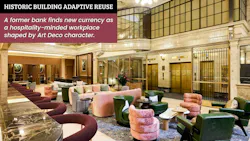
In Toronto’s financial district—defined largely by glass office towers—one workplace is taking a different approach. At iQ Offices on 302 Bay Street, a historic banking landmark has been transformed into a hospitality-driven workplace where Art Deco architecture shapes the modern office experience for Toronto Financial District professionals.
Arcadis, a global design and planning firm, transformed the 14-story, former bank building into a hospitality-inspired co-working destination with a strong presence in the financial district. The workplace is structured as a sequence of experiences across floors, beginning with a highly social, hospitality-driven ground level and progressing into more focused, semi-private, and formal environments, according to Mahsa Saeedi, project lead at Arcadis.
“The original vision was to reimagine the workplace as an experience, shifting away from a purely productivity-driven model toward an environment designed with intention, where people feel, connect, and perform at their best,” Saeedi said.
Designing With History, Not Around It
The Arcadis team decided to embrace the Art Deco opulence—not solely to respect the original architecture but to preserve the landmark’s character. So they melded Art Deco with the intimacy of a boutique hotel by adding contemporary design elements to bridge modern functionality and vintage inspiration.
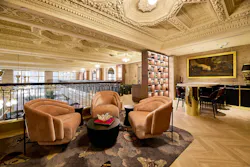
For example, the Banking Hall features high decorative ceilings, marble, and bold material choices to represent the strength people typically expect of a bank. During the restoration process, Arcadis introduced contemporary elements such as warm woods and brass through clean lines to enhance the space. Rather than competing with the richness of the historic architecture, these interventions were intentionally minimal and restrained.
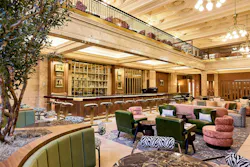
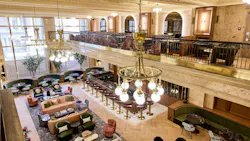
Marble cladding and stone columns offer a sense of assurance, complemented by layered lighting and vintage-inspired furnishings for the Grand Hospitality Lobby, which wouldn’t be complete without a barista bar to support tenant and visitor networking.
“This space was so grand and monumental, we didn’t want to create small rooms,” Saeedi explained. “As soon as you walk in, you still maintain adjacencies and spatial requirements. We wanted to preserve that scale and use it intentionally, to create a memorable arrival moment and a social heart that supports movement between different modes of work.”
Designers used a contemporary material palette through layered materials and textures to add softness and warmth to the building, complementing the boldness of the Art Deco and 19th century artwork.
The Challenge of Designing Inside a Heritage Structure
Unlike new construction projects that start as a blank canvas, some adaptive reuse projects come with design limitations due to their historic significance—like the iQ Offices. Arcadis worked with a heritage consultant to apply for the necessary permits and ensure any changes are carefully integrated to protect and enhance the building’s legacy with no major or permanent interventions to the original fabric.
“When we wanted to make decisions about design, we started every design decision by asking how the original architecture could guide the new program, rather than simply accommodating it,” Saeedi said. “The goal was keeping all those characters and translate it into a contemporary workplace experience.”
For instance, the original building featured a spiral staircase as a focal point between two floors. Handrails were removed and preserved until renovations were completed in that space, then reinstalled to meet preservation requirements. Arcadis opted not to subdivide the Banking Hall into smaller offices or interconnected meeting spaces, allowing the space to remain open and preserving the full expression of its height, ceiling detailing, and overall spatial volume.
Other layers of the design include the furniture, barista, and lighting strategy, which posed a challenge. In terms of updating those features and amenities, Saeedi noted that nothing could be permanently attached to the interior structure.
“Any new addition had to be added in a way that was respectful and often reversible. The main point was creating free-standing or reversible elements,” she said.
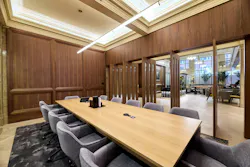
With preservation of historical plaster ceiling and wall elements as an obligatory priority, the addition of doors for ground-floor meeting spaces was confined to bulkheads and certain walls.
Hospitality-Driven Spaces for Different Ways of Working
Workplace design has evolved toward creating curated experiences that shape how people feel, connect, and move through the space throughout the day. Recently, the trend has shifted toward hospitality-driven design that prioritizes comfort and experiences not possible at home—an approach reflected at iQ Offices.
Unlike traditional office environments, the Toronto offices feature various seating options—from hightop tables to lounge seating and meeting rooms—supporting collaboration and focused work. Saeedi noted how traditional offices don’t accommodate this level of variety and flexibility.
At iQ Offices, the hospitality-driven design is seen floor-by-floor. The ground floor welcomes professionals into the Grand Hospitality Lobby, designed with various soft seating options and textiles to encourage connection and socialization, as well as a staffed barista bar offering hot and cold beverages. To create a club-like experience, a spiral staircase serves as a spatial connector and a heritage element with the mezzanine level on the second floor, featuring semi-private and private rooms that offer quieter work zones, semi-private seating areas, and meeting rooms. For larger groups, workers can engage in formal conference rooms on the third floor.
“On the second floor, one of the meeting rooms is also a game room with a mini bar,” Saeedi shared. “Within that room, we needed to preserve the cladding on the walls as they were heritage. So, everything has an identity.”
The remaining floors consist of co-working spaces, and the top floor features executive suites and a rooftop terrace offering fresh air and an inspiring city skyline. The terrace invites gatherings, combining opportunities for connection with needed views of the outdoors to support occupants’ well-being.
Designers seamlessly worked amenities into various spaces to enhance their attractiveness and purpose, while respecting existing architectural detail and incorporating it as part of the design personality.
Modern Infrastructure Integration into Historic Architecture
According to Saeedi, the iQ Offices adaptive reuse project required creative solutions from the Arcadis team in order to maintain the building’s visual clarity and the “dominant presence” of the historical architecture.
“Whatever we wanted to do, we had to think about the impact it was going to have on existing elements. In contrast, when we work on other projects, we bring everything back to base with a blank canvas and work on that,” said Saeedi.
For instance, old flooring is usually removed during construction before laying a new floor and installing new finishes. Since that wasn’t an option, due to the heritage constraints, the original flooring had to be preserved. As a result, the new flooring was carefully detailed to be installed over the existing surface, ensuring the heritage flooring remained protected.
Mindful design decisions like these enabled Arcadis to preserve the legacy of a banking landmark in Toronto even as the design transformed the building into a commercial space where Art Deco architecture complements workplace functions. By embracing the former bank’s sophistication and character, the reimagined iQ Offices demonstrate how historic architecture and contemporary workplace strategies can coexist—creating functional and welcoming environments that inspire today’s professionals.
About the Author
 Lauren Brant
Lauren Brant
Staff Writer, interiors+sources and BUILDINGS
Lauren Brant is Staff Writer for both interiors+sources and BUILDINGS. She is an award-winning editor and reporter whose work has appeared in daily and weekly newspapers. In 2020, the weekly newspaper won the Rhoades Family Weekly Print Sweepstakes—the division winner across the state's weekly newspapers. Lauren was also awarded the top feature photo across Class A papers. She holds a B.A. in journalism and media communications from Colorado State University-Fort Collins and a M.S. in organizational management from Chadron State College.